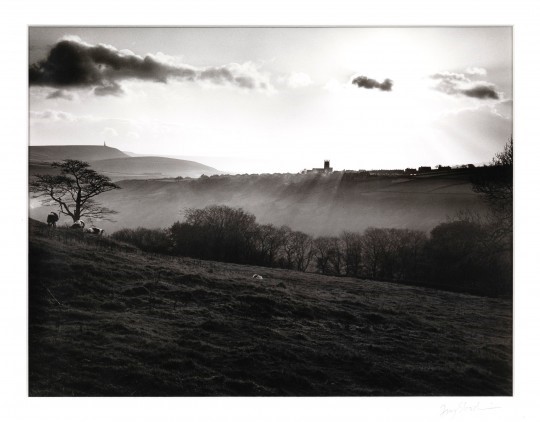
Jem Southam is Emeritus Professor of Photography at the University of Plymouth. He is best known for a number of series of colour landscape photographs, mainly based on the South West of England, which began in the 1970s and which he continues to build on to the present day. These have been collected so far into a number of separate books notably: The Red River (1989), Landscape Stories (2005), Rockfalls and Ponds (2011) and The River Winter (2012).
Southam’s work is characterised by a patient and measured observation of the same location often over a many months or years. Using a large format 10×8 plate camera and colour negative film, he is known to take considerable time in considering each image before finally committing the scene to camera. He describes this process as image “making” rather than image “capturing” which is a term he dislikes. In a text written to accompany the Victoria and Albert Museum’s exhibition “Jem Southam: Path to a Picture” in 2006, its noted that he:
“…observes the balance between nature and man’s intervention and traces the cycles of decay and renewal. His work combines topographical observation with other references: personal, cultural, political, scientific, literary and psycological.1”
In an interview with Andrew Nadolski from 1st March 2013 entitled “Stories from the Land”, Southam describes his passion for photography and the concepts and processes that define his work2. As part of this interview, he explains how the concept behind the book “The River – Winter” came about. It followed a chance encounter with a teacher who was exploring a child’s awareness and development of concepts in general, and in this case a river in particular. From this encounter, Southam initially posed the question “what is a river”, and from this came his own concept for the project which would be to try and define what a river is by the act of photographing one.
But in addition to this, he goes on to describe how he still felt that “the pictures would not be informed by the generations living those long dark winters and as a result I think it would miss something, so my pictures come from my personal background and my own life’s living, and I believe I believe I make better work that way”3.
I particularly admire this very personal investment in the concept and process, which seems to me is fundamental to producing the best work.

Jem Southam: River Exe at Bickleigh, 29 December 2010 from the book ‘The River – Winter’
In a youtube video of a lecture given by Southam in February 2020, (Rockfalls, Ponds and Rivers or “a clamour of voices”) he elaborates on this very personal approach and explain how he is passionate about and fascinated by the photographic process itself: “I like just going out, with a little box, and sticking it somewhere in the world, and just seeing what happens. That’s what I love doing”4.
In his seminal work, The Red River, he follows the path of a Cornish river from its source in the moors above Cambourne to where it reaches the sea at Gwithian in St Ives Bay. Across 50 photographs taken over a 5 year period in the 1980s, he tracks its path, creating both a topographical history of the route of the river and a cultural history of the land it passes through. Overlaid on to this is also an allegorical journey that incorporates the “potency of mythic narratives”5, such as the creation myth, dark forests, arcadia and flood myths. All of this ties back to a theme which he says runs through all of his work and is the subtitle to the lecture – that of the “clamour of voices”6. This is the idea that as we grow up and engage with the world, we are bombarded by information from hundreds of sources – books, magazines, stories – this accumulated knowledge stays in our minds and as we dwell on it from time to time, it provides a creative force for our work.
What comes across from all of the work by Jem Southam is a profound humanism and a deep desire to translate the love of the landscape and its cultural history into an accessible and enduring photographic record. This dedication is exemplified by the longevity of projects and the repeated return to the same places to see how they have evolved and continue to evolve as they interact with the presence of humans. The series The Pond at Upton Pyne (from Rockfalls and Ponds published in 2013) is a typical example of this. Southam originally found the pond by chance as he was driving through the village near Exeter. But he returned to the site many times over a 5 year period between 1996 and 2001 as it was slowly transformed by one local in particular and then by another.

In an interview Martin Parr [no date acknowledged for the interview]7, Southam describes how he always wanted to be a “colour landscape photographer” and it is true that all his published work is in colour, apart from an early series of photographs of the docks at Bristol in the late 1970s. This is interesting given the propensity of most photographers at the time to have been working in black and white. Southam was at the forefront of the development of colour landscape photography working in with his large format colour negatives and developing and printing all his own work.
I am still at a stage of working in both colour and black and white depending on the circumstances and the subject but I am fascinated how Southam has seen no need to go back to black and white photography. I also admire the way in which the whole photographic process is slowed down by Southam (he typically took no more than 50 images in a year) so that he can really focus on the composition and intent of each photograph – that seems to me to be an important skill for me to develop, particularly in a digital age where images can be produced ad nauseum without attention to detail, if the process is not carefully controlled.
References