
Collaboration
The collaborative exercise this week was a great opportunity to get to know better other people on the course and to get more of an insight into their practices and methodologies. Working as a team, myself, Ruta Saksensa and Mike Browne produced a short video on the field of vision of sheep. The purpose of the video was to illustrate that not all animals, including humans, have the same field of vision and that animals have adapted their vision capabilities to suit their needs. A shortened version of the video is reproduced below.
I have not really worked with others in photographic projects before so this was a new experience and I thoroughly enjoyed it. It was exhilarating to share our different views and ideas and reach a consensus on the final shape of the project, and then to work together on different strands of the production to realise the finished video presentation.
SHEEP’S FIELD OF VIEW
By John Martyn, Michael Browne and Ruta Saksensa
We, humans, are used to see things from our perspective. But what about other species, what do other creatures see? Our group collaborated to produce an image that would represent a landscape from a sheep’s point of view.
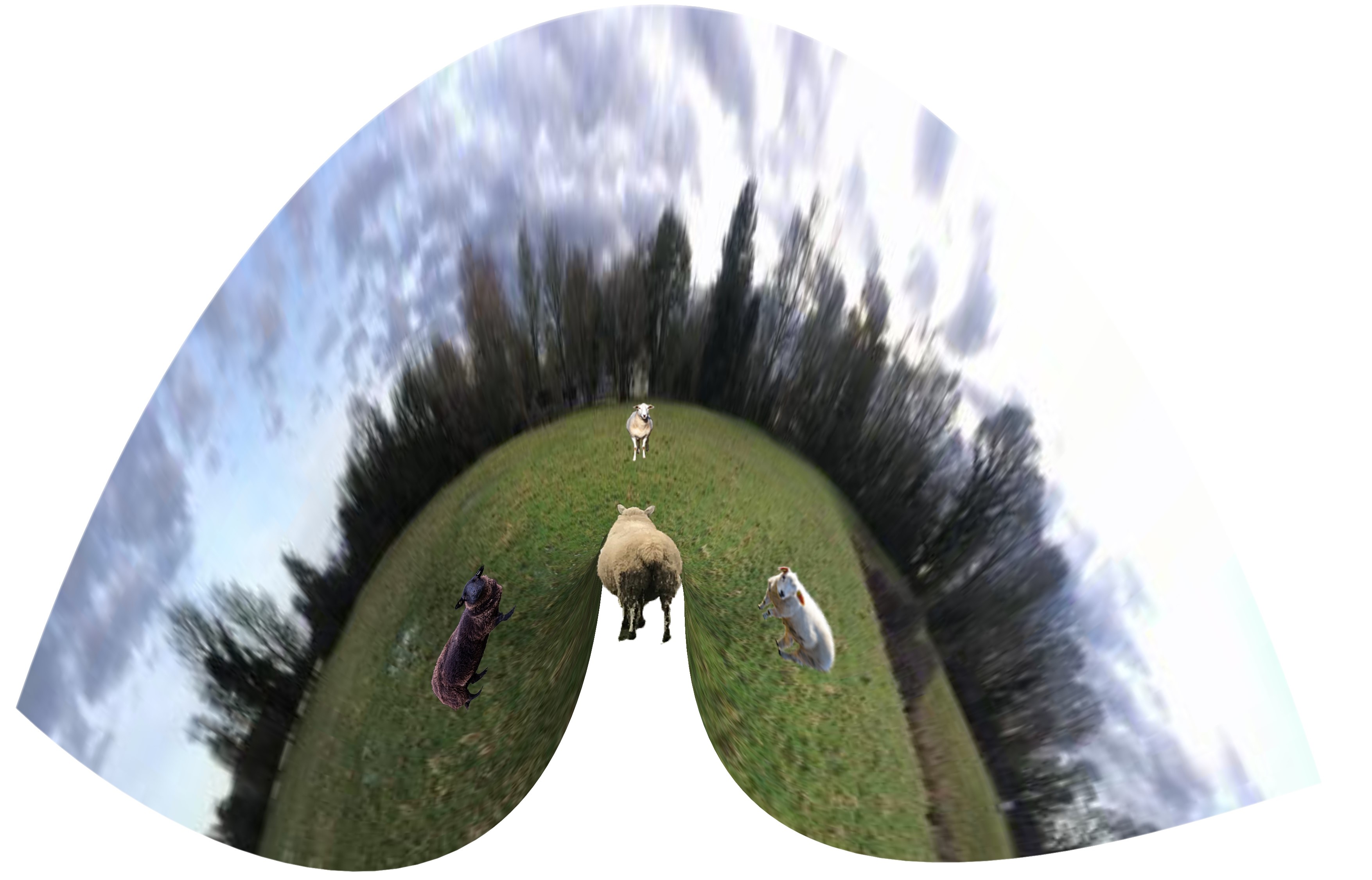
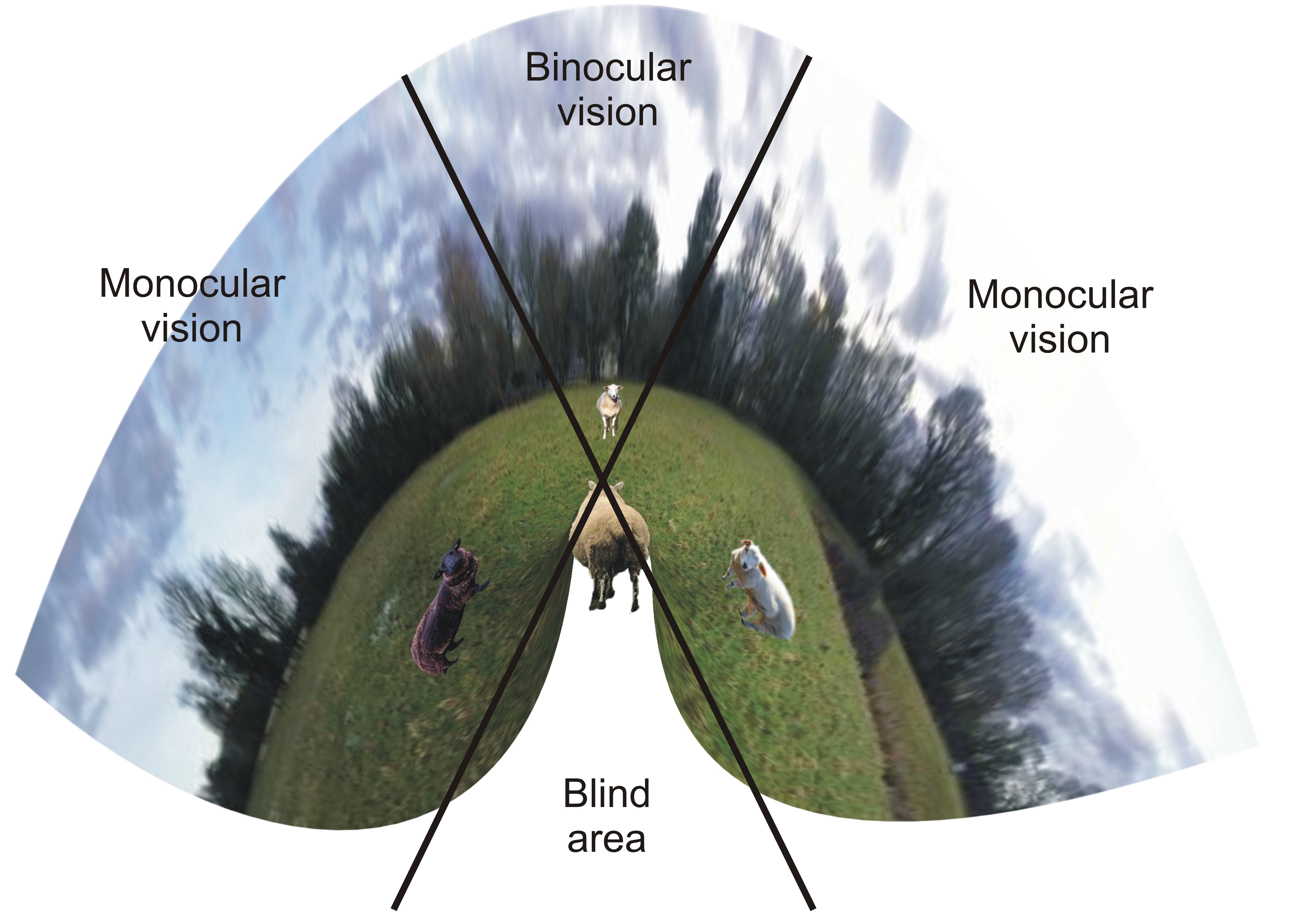
The viewer sees a panorama that is typical for a sheep to see. Sheep are one of the pray species that have a peripheral vision of nearly 360 degrees. To be more precise, their vision is in between 270 and 320 degrees, while, in comparison, human vision is only about 155 degrees on average (Amelinckx 2017). When taking a closer look at a sheep’s pupils, it is possible to see that they have a horizontal pupil in comparison to a round pupil that humans have. The main reason why sheep and other pray animals need a wider field of view (a panoramic vision) is very simple – it is because they need to be aware of predator presence around them.
AMELINCKX, Andrew. 2017. 6 Fun Facts About Sheep You might Not Know. Modern Farmer Media 2021 [online]. Available from https://modernfarmer.com/2017/12/6-facts-sheep-might-not-know/ (Links to an external site.) [accessed 15 February 2021].
Ariella Azoulay describes in the article “Photography Consists of Collaboration”1how she, Susan Mieselas and Wendy Ewald came together to collaborate on a number of projects and in particular to research and present the different ways in which collaboration itself is undertaken.
She also describes how Ewald has worked on many photographic projects as part of her teaching, and the two way communication that has resulted from this between her and those she is teaching: “At the core of this project is an attempt to use the camera, the act and the event of photography, and the relations that they create in order to teach people to reposition themselves in relation to others in their community; to appreciate the value of one’s own experiences, culture, and dreams; and to recognize the value of sharing these things with others through photography”2.
It seems to me that in this duality is the essence of successful collaboration and it is something that I am looking to develop as well in my own Photographic Studio, by running projects which others can participate in, in order to create a firm, and hopefully lasting, dialogue between photographer and community.
As Azoulay goes on to say “..collaboration in photography cannot be limited to the question of how to engage others in the event of photography but must also ask how the photographer herself engages with act of photography”3.
Authorship
Briefly, I have no time for plagiarism and the blatant, unacknowledged copying of other people’s creative work.
That said, it’s hard to ignore completely the quip generally attributed to Pablo Picasso that “…good artists copy, great artists steal.” There is undoubtedly much to be gained from the sharing of ideas and the collaborative process, as long as it is acknowledged mutually where appropriate.
Notes
1 – Azoulay, A, Mieselas, S, Ewald, W. (2016) Photography Consists of Collaboration: Susan Mieselas, Wendy Ewald, and Ariella Azoulay. Camera Obscura 91, Volume 31, Number 1. © Camera Obscura. Published by Duke University Press.
2 – ibid, pp 190.
3 – ibid, pp 191.